
New research finds the UK fertility conversation is broken: most people want comprehensive care beyond IVF, but aren't getting it

April 30, 2026
Carrot
2 min
LinkedIn Icon
Among the UK respondents in a survey of more than 1,000 adults across the US, UK, Canada and Ireland, demand for metabolic health, men’s health, and less invasive fertility options runs high, but only around a third have discussed them with a provider
Doctor talking with patient

Most people navigating fertility journeys want comprehensive and lower-cost options before in vitro fertilisation (IVF), including metabolic health, men’s health, and less invasive treatment pathways. But the conversations that would connect them to those options aren’t happening. A new report from Carrot, a global fertility, family-forming, and hormonal health care platform, reveals the gap between what people want and what they’re being offered.

The report, “Beyond IVF: What People Really Want from Fertility Care,” draws on a survey of 1,010 adults across the United States, United Kingdom, Ireland, and Canada who are currently trying to conceive, have tried in the past five years, or plan to try within the next five years. The findings below are drawn from the 168 UK respondents. The findings reveal a consistent pattern: people want more options, earlier guidance, and care that does not default immediately to the most invasive or costly treatments.

“People are telling us exactly what they want, earlier guidance, more options, and care that doesn’t default to the most invasive treatment first,” said Tammy Sun, Founder and Chief Executive Officer of Carrot. “The gap between that demand and what the system currently delivers is not subtle, and it is not inevitable. Clinicians want to offer comprehensive care. They need benefit structures and care pathways that make room for it.”

The report identifies four core gaps shaping the current fertility care experience: high awareness of IVF paired with resistance to pursuing it, strong interest in metabolic and men’s health support without corresponding clinical engagement, delayed fertility education, and growing demand for comprehensive fertility benefits.

IVF awareness is high, but so is resistance

While awareness of IVF is high among UK respondents (80.8%), willingness to pursue it is significantly lower (57.1%), representing the largest gap between awareness and consideration of any fertility option in the study, at 24 points.

Cost and invasiveness are the primary drivers of IVF resistance: 83.3% of UK respondents said they would choose lower-cost options first, and 81.5% said they would prefer to try a less invasive option before IVF if supported by clinical guidance. When asked what would shift their path, 75.3% said a better understanding of non-IVF options would make them more likely to pursue those alternatives first. Even so, nearly half of UK respondents (49.4%) were not given a detailed discussion of other options before IVF was raised with them.
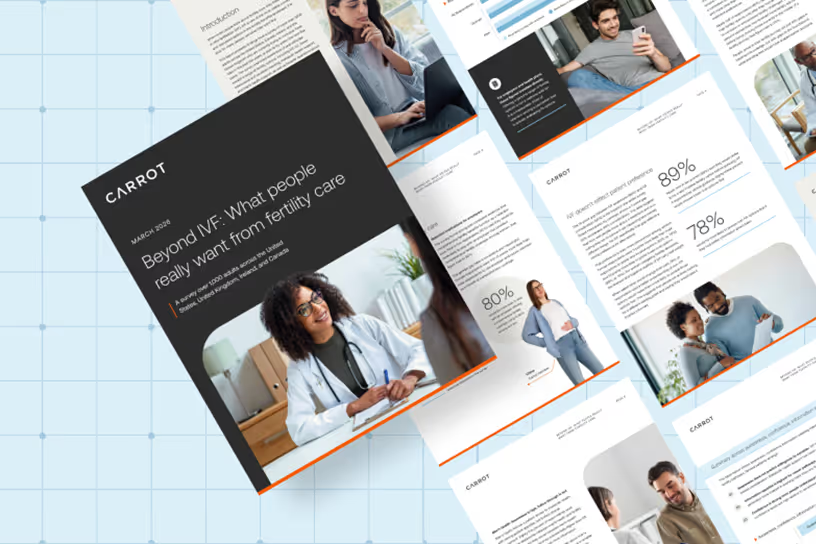
Beyond IVF

What people in the UK really want from fertility care
Download the full report
arrow_forward

Metabolic and men’s health generate interest, but not clinical engagement

Metabolic and men’s health support emerged as two of the most sought-after fertility pathways. Among UK respondents, 81.3% said they would consider metabolic health support, and 77% said they would consider men’s health support, both exceeding the 57.1% who would consider IVF. However, only around a third reported discussing these topics with a provider (33% for metabolic health and 36% for men’s health), indicating a gap between patient interest and clinical integration.

“These findings confirm what many of us in the field have long observed: factors like metabolic health, nutrition, and lifestyle are central to fertility outcomes yet rarely addressed in a structured, ongoing way,” said Asima Ahmad, Chief Medical Officer at Carrot.

Fertility education comes too late

UK respondents received meaningful fertility education at 21 on average, nearly four years later than they believe it should begin. More than half (53%) said they wished they had known more before trying to conceive, and 42% felt they learned too late.

Comprehensive fertility support drives retention

81.3% of UK respondents said that access to multiple fertility options would make them feel more confident in their decisions, the most widely endorsed statement in the survey. 69.9% said they would be more likely to stay with an employer offering comprehensive fertility coverage, and 73.1% said the same about their health plan.

These retention figures sit below the global average, and the reason is structural. UK employees are 12 points less likely than their global peers to cite fertility benefits as a reason to stay (69.9% versus 81.9%), because NHS provision sets a baseline expectation of some fertility care. For UK employers, that raises the bar: the most compelling case for a fertility benefit rests on the quality, range, comprehensiveness and speed of what is on offer, not on coverage as a concept.

Together, the findings indicate that expanding access to a broader range of fertility pathways, and introducing them earlier in the journey, may better align care delivery with patient preferences while also supporting workforce retention. For UK employers in particular, comprehensive, well-communicated fertility support is both a benefit-design decision and a retention one.

Read the full report.